Quick answer
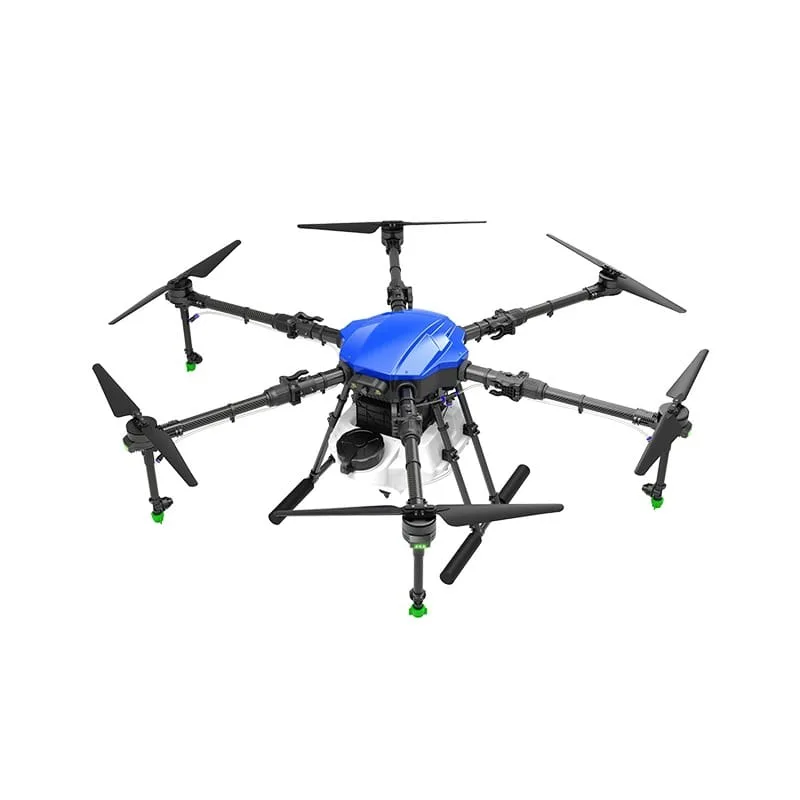
An agriculture spraying drone carries a tank of diluted pesticide or liquid nutrient, pumps it to nozzles under its arms and sprays while flying a GPS-planned path over the field. The rotor downwash pushes droplets into the canopy. Spray quality depends on height, speed, nozzle type, droplet size and weather — and on a certified, trained pilot.
Key takeaways
- Key parts: frame and arms, motors and propellers, tank, pump, nozzles, flight controller, GNSS, batteries.
- Terrain-following radar and obstacle sensing make uneven fields much safer to spray.
- Centrifugal nozzles allow finer droplet control; pressure nozzles are simpler to maintain.
- Check type certification, spares availability and service support before anything else.
Main parts of a spraying drone
Frame, arms, motors and propellers
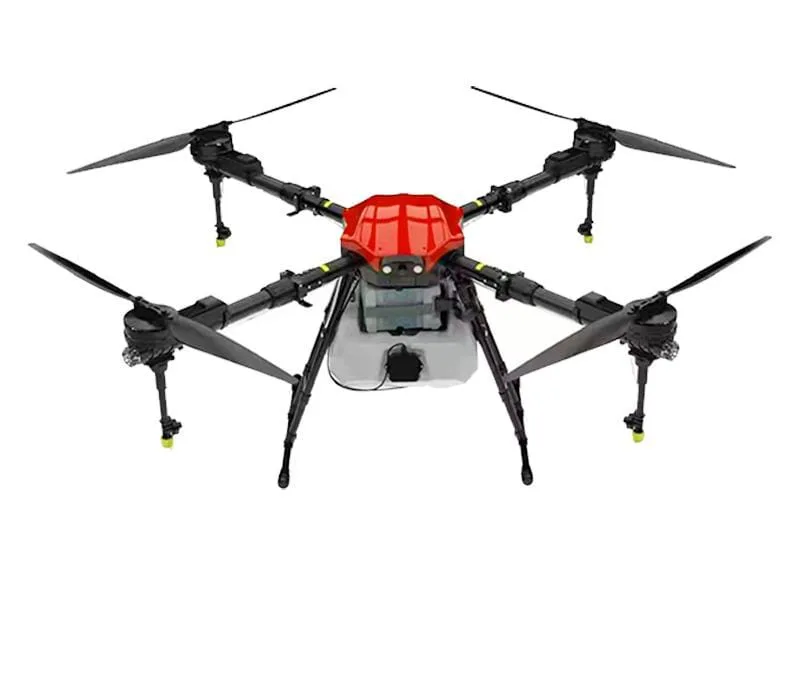
Spraying drones usually have four, six or eight rotors. More rotors spread the load and add redundancy. Foldable arms make transport easier, and carbon-fibre or reinforced composite frames keep weight down. Propellers are consumables and should be inspected before every flight.
Tank, pump and nozzles
The tank holds the spray mix; common classes are 10, 16 and 20 litres. A pump sends liquid to the nozzles at a controlled flow rate. Pressure (fan) nozzles are common and easy to clean, while centrifugal nozzles spin to create droplets of adjustable size.
Flight controller, GNSS and sensors
The flight controller keeps the drone stable and follows the planned route. GNSS (GPS and other satellite systems) gives position; RTK adds centimetre-level accuracy. Radar or vision sensors handle terrain following and obstacle avoidance.
Batteries and charging
Smart lithium batteries power the drone for short sorties. Field work needs several battery sets, a fast charger and usually a generator, so one set charges while another is flying.
How drone spraying works, step by step
- Field inspection: boundary, obstacles, power lines, trees and a safe take-off point
- Mission planning: the field is mapped in the app and the route, height, speed and swath are set
- Mixing: the product is diluted as per the label and filled into the tank with PPE on
- Flight: the drone flies parallel rows; downwash pushes droplets into the canopy
- Refill and battery swap: the drone returns automatically and resumes from where it stopped
- Records: area, product and time are logged for the farmer
Pressure vs centrifugal nozzles
| Point | Pressure (fan) nozzles | Centrifugal nozzles |
|---|---|---|
| Droplet size control | Set by nozzle tip and pressure | Adjustable via disc speed |
| Maintenance | Simple; tips can clog | More parts; less clogging |
| Typical use | General crop spraying | Fine, even coverage where drift control matters |
10-point checklist before you buy or hire
- Valid DGCA type certificate (opens in a new window) and UIN registration support
- Tank class suited to your field size and terrain
- Number of battery sets, charger and generator in the package
- Terrain following and obstacle sensing
- Nozzle type and droplet size settings
- Route planning app in a language your pilot is comfortable with
- Warranty terms in writing
- Spare parts stocked near you
- Training for the pilot and ground crew
- Response time for repairs during the season
Common problems with spraying drones and how to avoid them
Most field problems with spraying drones come from preparation, not from the drone itself. A few habits prevent the majority of lost days during the season.
Clogged nozzles and filters
Poorly mixed wettable powders, dirty water and leftover residue block nozzles and strainers. Pre-mix powders in a bucket, filter the water and flush the system with clean water after every job.
Uneven spray and missed strips
Wrong swath width, gusty wind or a drifting GNSS signal leaves untreated strips. Confirm the swath setting for your nozzle type, keep overlap between passes and stop when the wind rises.
Battery and power issues
Flying on hot or partly charged batteries shortens their life and can cause a forced landing. Let batteries cool before charging and keep the charger and generator in the shade.
Frequently asked questions
How does an agriculture spraying drone work?
It flies a GPS-planned route over the field, pumps the spray mix from its tank to nozzles and releases droplets that the rotor downwash pushes into the crop canopy.
How many acres can a spraying drone cover in a day?
It depends on tank size, battery sets, field shape, refilling speed and weather. Ask the operator for a realistic estimate for your field instead of relying on advertised maximums.
Which is better — a 4-rotor or 6-rotor spraying drone?
Both can work well. Six or eight rotors offer more redundancy and stability with heavy loads; four rotors are simpler and lighter. Certification, support and spray quality matter more than rotor count.
Can a spraying drone spread granules or seeds?
Many models accept a spreader attachment for granules or seeds. Check whether the model supports it and whether the product is suitable for aerial application.
Who can fly an agriculture spraying drone?
A person holding a Remote Pilot Certificate from a DGCA-authorised training organisation, flying a registered drone of a certified type.
How often does a spraying drone need servicing?
Do a pre-flight check every time, clean the tank and nozzles after every job and follow the manufacturer's service schedule for motors, pumps and batteries.
What is the difference between a spraying drone and a normal camera drone?
A spraying drone is a much larger, heavier aircraft built to carry a liquid tank, pump and nozzles, with farm-specific software and sensors. A camera drone only carries a camera and cannot be used for spraying.
About this guide
- Written by
- Kisan Drone team, Noida. We work with farmers, FPOs and drone operators on spraying, buying and training questions.
- Reviewed by
- Mohit Singh, Drone Operator — 10 years of drone-spraying experience
- Last updated
How we write
We do not publish invented prices, subsidy amounts, yields or reviews. Rules and schemes are checked against official sources, and anything that depends on your crop, product or location is marked as such. Found an error? Email enquiry@kisandrone.co.in.